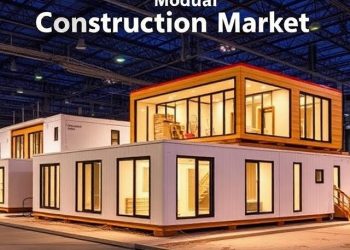
Construction has always been one of humanity’s oldest and most essential industries — but also one of its most inefficient. Weather delays, labor shortages, material waste, cost overruns, and months-long timelines have long defined the traditional building experience. Modular construction is changing that narrative decisively. By shifting the bulk of building activity into controlled factory environments and assembling finished modules on-site, this method is rewriting the economics and timelines of construction across the globe.
According to a comprehensive analysis by Market Research Future, the global modular construction market was valued at USD 105,805.4 million in 2024 and is projected to reach USD 213,456.7 million by 2035, growing at a compound annual growth rate (CAGR) of 6.6% during the forecast period 2025–2035. This near-doubling of market value reflects a profound and accelerating shift in how the world builds — driven by housing demand, labor constraints, sustainability imperatives, and digital innovation.
Why Modular Construction Is Having Its Moment
The case for modular construction rests on a compelling combination of speed, cost, and sustainability. Because factory fabrication of modules can occur simultaneously with on-site foundation and utility work, overall project schedules can be reduced by 30% to 50% compared with conventional methods. For a hospital system needing a new patient wing, a municipality facing a housing crisis, or a corporation expanding its logistics network, this time advantage is not merely convenient — it is transformative.
Labor shortages are adding further urgency. The global construction workforce is shrinking in many developed economies, as skilled tradespeople retire and fewer young workers enter the sector. Factory-based modular production addresses this directly: standardized, repeatable assembly-line processes allow fewer workers to produce larger volumes of high-quality building components, with less dependence on fluctuating on-site labor availability and weather conditions.
Sustainability is the third major driver reshaping the modular construction market. Compared to traditional construction, modular methods can reduce construction waste by up to 80% through precision manufacturing, optimized material use, and factory-level recycling. Embodied carbon is also significantly lower, particularly when reusable steel and concrete frames are employed. Solar-integrated modules are becoming standard in markets like China and India, while Europe’s stringent green building standards are further accelerating the adoption of factory-built, energy-efficient structures.
Get An Exclusive Sample of the Research Report: https://www.marketresearchfuture.com/sample_request/1682
Segment Insights: Steel Dominates, Wood Grows Fast
Steel is the dominant material in modular construction, valued for its exceptional strength, durability, and suitability for high-rise and large-scale applications. A modular office complex in Chicago demonstrated this advantage clearly — prefabricated steel frames and panels enabled completion several months ahead of equivalent conventional timelines while meeting rigorous performance standards.
Wood, however, is the fastest-growing material segment, driven by the rise of engineered timber products such as cross-laminated timber (CLT) and laminated veneer lumber (LVL). These materials combine structural strength with a dramatically lower carbon footprint, making them particularly attractive in sustainability-conscious markets. In Europe, countries like Germany, Austria, and Sweden are deploying CLT in multi-story modular residential developments, achieving both rapid delivery and high energy efficiency. In North America, wood modular construction is increasingly favored for single-family homes, townhouses, and small commercial buildings.
In terms of construction method, volumetric modular — where entire three-dimensional room-sized units are fabricated and finished in the factory before delivery — holds the largest market share. The method is especially effective for standardized building types such as student housing, hotel rooms, and healthcare facilities. Panelized construction, using prefabricated two-dimensional wall, floor, and roof panels, is the fastest-growing method, offering greater design flexibility and ease of transport for more complex architectural projects.
Residentially, the segment commands the largest share of the market, driven by the global affordable housing crisis and the need for rapid urban housing delivery. Commercial and industrial applications are the fastest-growing end-use category, as businesses deploy modular methods for warehouses, logistics hubs, and data centers — where speed to operational readiness is a critical competitive advantage.
Buy this Premium Research Report: https://www.marketresearchfuture.com/checkout?currency=one_user-USD&report_id=1682
Regional Dynamics
North America leads the global market, propelled by US federal infrastructure programs, municipal affordable housing initiatives in cities like New York, Toronto, and Chicago, and strong demand from healthcare and education sectors. Europe is a mature but highly innovative market, with Germany, the UK, Sweden, and the Netherlands leading in sustainable and digitally integrated modular solutions. Asia-Pacific is the fastest-growing region, anchored by China’s massive construction output, Singapore’s high-rise modular adoption, and India’s housing demand. In June 2025, Laing O’Rourke inaugurated the UK’s first dedicated Modern Methods of Construction training facility — a milestone reflecting the industry’s commitment to workforce development and long-term capability building.
For more insights on Market, visit the Market Research Future page and explore detailed market analysis, forecasts, and company strategies.