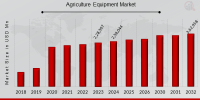

(EMAILWIRE.COM, June 16, 2025 ) According to a comprehensive research report by Market Research Future (MRFR), the Agriculture Equipment Market Information by Product Type, Function, and Region. Agriculture Equipment Market Size was valued at USD 2,28,307 Million in 2023. The Global Agriculture Equipment industry is projected to grow from USD 2,38,044 Million in 2024 to USD 3,62,958 Million by 2032, exhibiting a compound annual growth rate (CAGR) of 5.3% during the forecast period 2024 – 2032.
Agriculture Equipment Market Overview
Agricultural equipment encompasses a wide range of machinery used in various farming processes such as planting, harvesting, irrigation, fertilization, and crop protection. The market includes both heavy machinery like combine harvesters and tractors, and smaller equipment such as seed drills, sprayers, and tillers. The global agriculture equipment market is segmented based on product type, application, drive type, and region. Tractors continue to dominate the market, accounting for the largest share due to their versatile functionality and indispensable role in mechanized farming.
Asia-Pacific leads the global market, with countries like India and China showing significant demand due to their large agricultural sectors and government initiatives aimed at modernizing farming practices. North America and Europe are also key regions, especially due to the presence of established agricultural machinery manufacturers and high adoption rates of precision farming.
Request To Free Sample of Report: https://www.marketresearchfuture.com/sample_request/2182
Key Companies in the Agriculture Equipment Market include.
AGCO Corporation
Deere & Company
CNH Industrial
Kubota Corporation
Mahindra & Mahindra Ltd.
Iseki & Co., Ltd.
JC Bamford Excavators Limited
Daedong Industrial Co.
Escorts Limited
Claas KGAA MBH
SDF S.P.A.
Yanmar Holdings Co., Ltd.
Alamo Group Inc.
Bucher Industries
Market Dynamics
The market dynamics for agricultural equipment are shaped by several interrelated factors:
Population Growth and Food Demand: The growing global population is exerting pressure on agricultural systems to produce more food with fewer resources. This demand is pushing farmers to adopt high-efficiency machinery that can increase crop yield and minimize post-harvest losses.
Labor Shortages: In many developed and developing regions, agricultural labor is becoming scarce due to urbanization and aging farming populations. This labor gap is being filled by machines, leading to increased mechanization of agriculture.
Technological Advancements: The integration of technology, including automation, artificial intelligence (AI), and the Internet of Things (IoT), has led to the development of smart farming equipment. These innovations help monitor soil health, crop conditions, and machinery performance, improving overall efficiency.
Government Support: Various governments are promoting the adoption of modern agricultural equipment through subsidies, low-interest loans, and training programs. This support is crucial in emerging economies where high equipment costs can be a barrier to entry.
Key Market Drivers
Precision Agriculture: The adoption of GPS technology, drones, and satellite imagery is enabling farmers to make data-driven decisions. Precision agriculture equipment allows for efficient use of inputs like water, fertilizers, and pesticides, thereby improving productivity and sustainability.
Climate Change Mitigation: With agriculture being both a victim and contributor to climate change, modern equipment is helping to reduce greenhouse gas emissions through optimized fuel use, better soil management, and reduced waste.
Increased Mechanization in Emerging Markets: In developing countries, smallholder farmers are increasingly investing in basic mechanized tools to reduce manual labor and improve crop output. Leasing models and cooperative farming are making such equipment more accessible.
Purchase Complete Report: https://www.marketresearchfuture.com/checkout?currency=one_user-USD&report_id=2182
Technological Advancements and Innovation
Innovation lies at the heart of the modern agriculture equipment market. Key technological trends include:
Autonomous Tractors and Robotics: Self-driving tractors and robotic harvesters are being developed to reduce dependence on manual labor. These machines can operate with minimal human intervention, optimizing fuel and time efficiency.
Electric and Hybrid Equipment: In line with global sustainability goals, manufacturers are introducing electric-powered tractors and machinery. These models emit lower emissions and operate more quietly, making them ideal for both environmental and operational efficiency.
IoT-Enabled Devices: Sensors installed in farming equipment can relay real-time data on weather, soil health, and crop conditions. Farmers can access this data through apps, enabling more informed and timely decisions.
Telematics and Predictive Maintenance: Advanced diagnostic tools and software are helping in real-time equipment monitoring. Predictive maintenance technology can forecast machine failures, thereby reducing downtime and repair costs.
Agriculture Equipment Market Segmentation:
Global Agriculture Equipment Product Type Outlook
Tractor
Harvester
Planting and Crop Processing Equipment
Cultivation & Soil Separation Equipment
Hay & Forage Equipment
Spraying Equipment
Others
Global Agriculture Equipment Function Outlook
Harvesting
Planting & Fertilizing
Haying
Plowing & Cultivation
Post Harvest & Arro Processing
Browse In-depth Market Research Report: https://www.marketresearchfuture.com/reports/agriculture-equipment-market-2182
Challenges and Market Constraints
Despite its promising growth, the agriculture equipment market faces several challenges:
High Initial Investment: The upfront cost of advanced equipment can be prohibitive for small and marginal farmers, particularly in developing nations. Financing solutions and rental services are critical to overcoming this barrier.
Lack of Technical Know-How: Operating and maintaining technologically advanced machinery requires skilled labor. In rural areas, the lack of training and awareness often hinders adoption.
Fragmented Land Holdings: In countries with small and scattered farms, large equipment may not be feasible, limiting market penetration.
Environmental Concerns: The use of heavy machinery can lead to soil compaction and other environmental issues if not managed properly. Manufacturers are increasingly focusing on eco-friendly designs to mitigate these effects.
Future Outlook
The agriculture equipment market is poised for significant transformation over the next decade. Key trends that are likely to shape the future include:
Expansion of Smart Farming: With the increasing adoption of digital tools, the integration of AI, big data, and blockchain into agriculture machinery will become more widespread. These technologies will allow for real-time monitoring and predictive analytics, enhancing productivity and sustainability.
Customized Equipment for Local Needs: Manufacturers are expected to design region-specific equipment suited to local crops, terrains, and farming practices. This approach will improve efficiency and increase adoption rates.
The agriculture equipment market is undergoing a major evolution, fueled by demographic pressures, technological innovation, and sustainability goals. While challenges such as high costs and lack of technical knowledge remain, the overall outlook is positive. Governments, private players, and technology providers must collaborate to create an inclusive, efficient, and environmentally sustainable agricultural ecosystem. As the global food landscape continues to shift, agricultural machinery will play a central role in feeding the world in a smarter and more sustainable way.
More Related Reports:
stainless steel welded pipe market
thermal transfer ribbon market
About Market Research Future:
Market Research Future (MRFR) is a global market research company that takes pride in its services, offering a complete and accurate analysis about diverse markets and consumers worldwide. Market Research Future has the distinguished objective of providing optimal quality research and granular research to clients. Our market research studies by products, services, technologies, applications, end users, and market players for global, regional, and country level market segments, enable our clients to see more, know more, and do more, which help answer your most important questions.