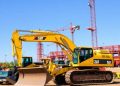
Behind every highway, bridge, high-rise, and mine lies a fleet of powerful machines that make it all possible. Excavators carving through rock, cranes lifting steel beams dozens of stories high, bulldozers reshaping terrain for new developments — heavy construction equipment is the physical force that converts blueprints into built reality. And as the world accelerates its investment in infrastructure, urbanization, and clean energy, the market for these machines is entering a sustained and substantial growth phase.
According to a comprehensive analysis by Market Research Future, the global heavy construction equipment market was valued at USD 206708.4 USD Million in 2024. The heavy construction equipment industry is projected to grow from 216465.54 USD Million in 2025 to 343316.86 USD Million by 2035, exhibiting a compound annual growth rate (CAGR) of 4.72% during the forecast period 2025 – 2035.This trajectory reflects the compounding effect of infrastructure mega-projects, emerging market construction booms, and a technology-driven transformation of the equipment industry itself.
The Forces Driving Demand
Urbanization is the most powerful and persistent demand driver in the heavy construction equipment market. As millions of people continue to migrate to cities — particularly across Asia, Africa, and Latin America — the need for housing, transportation networks, utilities, and commercial spaces creates a continuous and expanding pipeline of construction activity. Every urban expansion requires earthmoving, foundation work, material handling, and heavy lifting, all of which depend on sophisticated machinery.
Government infrastructure investment is amplifying this demand. Across the United States, Europe, China, India, and the Middle East, governments are channeling significant public funding into roads, rail corridors, ports, energy facilities, and smart city projects. These are not small-scale undertakings — they are multi-year, capital-intensive programs that generate sustained demand for heavy machinery over extended project cycles. Renewable energy infrastructure is adding a compelling new dimension: the construction of wind farms, solar installations, and hydroelectric facilities all require specialized heavy equipment for site preparation, foundation work, and component installation.
Regulatory pressure is simultaneously reshaping the equipment that contractors use. Emissions standards imposed by the EU, the US EPA, and counterpart bodies in Asia are pushing manufacturers toward cleaner, more efficient power systems. This regulatory environment is not just a compliance challenge — it is also a catalyst for innovation that is attracting new investment and differentiation across the industry.
Get An Exclusive Sample of the Research Report: https://www.marketresearchfuture.com/sample_request/681
Technology: The New Frontier of Competitive Advantage
Perhaps the most transformative trend in the heavy construction equipment sector is the integration of digital technology into machinery that was once entirely mechanical. Telematics systems now enable fleet managers to monitor equipment location, fuel consumption, engine health, and operator behavior in real time. IoT sensors feed data into predictive maintenance platforms, reducing unplanned downtime and extending equipment lifecycles. In November, Caterpillar announced a partnership with a leading technology firm to develop AI-driven predictive maintenance solutions — a move that signals how deeply digital intelligence is being embedded into the industry’s future.
Autonomy and remote operation are advancing rapidly. In 2023, Teleo signed agreements with multiple major contractors for the deployment of remotely operated wheel loaders, bulldozers, and dump trucks. Volvo Construction Equipment partnered with Nvidia to develop AI-driven autonomous construction machinery, integrating computer vision and machine learning into heavy equipment platforms. These developments point toward a future where human operators direct machines from control centers rather than cab seats — improving safety, precision, and productivity simultaneously.
The electric equipment revolution is also gaining momentum. Komatsu unveiled its latest line of electric excavators in 2023, and the electric power source segment is identified as the fastest-growing within the market. With battery technology improving and emissions regulations tightening, the transition from internal combustion engines to electric and hybrid drivetrains — while still in its early stages — is accelerating, particularly in Europe and urban construction environments.
Segment and Regional Highlights
Excavators remain the dominant equipment type by market share, valued for their versatility across excavation, demolition, and material handling tasks. Loaders are the fastest-growing equipment segment, driven by demand for efficient material movement in urban construction settings. In terms of application, excavation leads by volume while material handling is the fastest-growing application category, propelled by logistics and supply chain demands on construction sites.
Asia-Pacific is the largest regional market, with a market size of USD 80 billion in 2025, anchored by China’s massive construction output and India’s accelerating infrastructure programs. North America follows, supported by federal infrastructure investment programs and a wave of data center, semiconductor fab, and energy project construction. Europe’s market is shaped by sustainability mandates, with Liebherr and Volvo leading innovation in eco-efficient equipment design.
Buy this Premium Research Report: https://www.marketresearchfuture.com/checkout?currency=one_user-USD&report_id=681
For more insights on Market, visit the Market Research Future page and explore detailed market analysis, forecasts, and company strategies.